News Articles
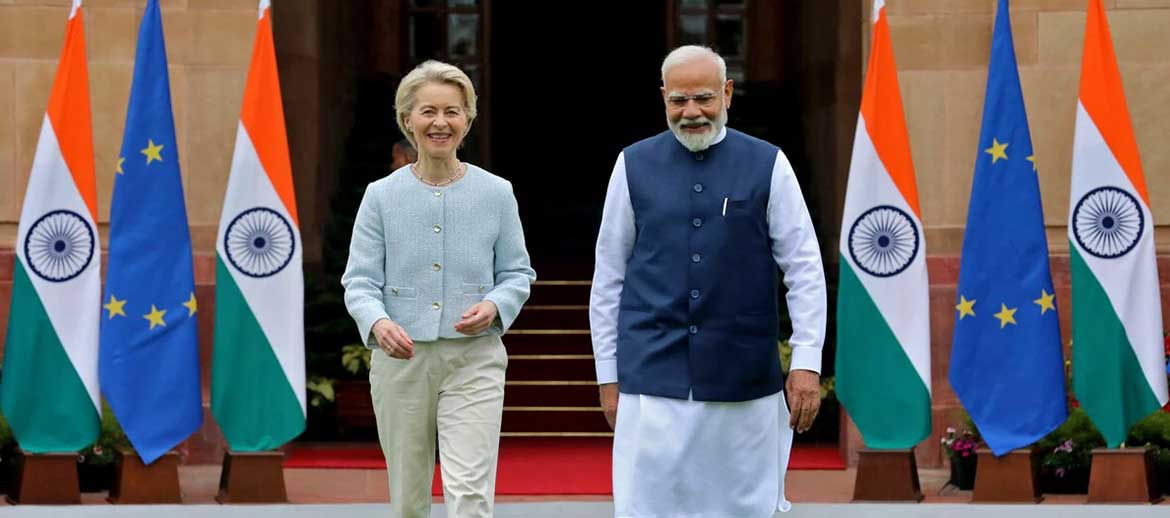
India and the European Union have concluded a long-negotiated free-trade agreement, a move both sides are framing as a major step toward deeper commercial integration at a time when global trade is becoming more contested and more politicized.
Speaking at a major industry gathering, India's prime minister described the pact as a landmark deal and positioned it as a boost for multiple export-heavy sectors, including textiles, gems and jewelry, leather goods, and footwear. Officials indicated that further details, including implementation timelines, tariff schedules, and sector-specific provisions, would be outlined following the conclusion of related high-level meetings.
The agreement links two large economic blocs and creates a combined market of roughly 2 billion people. Supporters argue that scale matters in the current environment, where supply-chain resilience, market access, and rule-setting are increasingly tied to geopolitical risk and industrial-policy competition. In that context, India is looking to strengthen trade corridors that can sustain export growth, attract investment, and broaden its options beyond any single destination.
For New Delhi, the timing is especially important. With U.S. tariffs weighing on portions of India's export profile, policymakers have been emphasizing diversification and new trade corridors. The EU agreement adds to a sequence of recent trade moves that India has pursued to reduce exposure to tariff-driven shocks and to improve long-term access to high-income consumer markets.
The EU, for its part, has signaled a preference for expanding structured trade relationships rather than relying on ad hoc tariff measures. European officials have publicly emphasized a trade approach centered on partnership, predictability, and sustainability, positioning new agreements as tools to reinforce supply chains and strengthen competitiveness across the bloc.
Trade volumes between India and the EU are already meaningful. European Commission figures indicate that goods trade between the EU and India exceeded €120 billion in 2024, making the EU one of India's most important commercial partners. India's export mix to the bloc is broad, with strengths ranging from textiles to industrial goods, as well as chemicals and mineral-related products. The EU's exports to India are also diversified, with machinery and appliances, transport equipment, and chemicals among the most prominent categories.
Despite that scale, India remains a smaller trading partner for the EU than the bloc's largest counterparts. India accounted for about 2.4% of the EU's total trade in goods in 2024, well behind the shares held by the United States, China, and the United Kingdom. That gap highlights both the opportunity and the challenge: India has room to expand its share, but doing so will depend on execution, competitiveness, logistics, and regulatory alignment.
The agreement also fits into India's broader European trade strategy. Officials have described it as complementary to other European-facing arrangements, including recent deals with the United Kingdom and with the European Free Trade Association. In practical terms, overlapping agreements can improve coverage across markets, reduce friction for exporters operating across multiple jurisdictions, and support longer-term investment decisions tied to supply-chain placement.
Even so, analysts caution that the EU pact is not a complete substitute for stronger trade access to the United States. The U.S. remains India's largest single export market, and India's goods trade surplus with the United States has historically been larger than its surplus with the EU. In 2024, India's goods surplus with the United States was about $45.8 billion, compared with about $25.8 billion with the EU, underscoring the centrality of the U.S. market to India's external position.
The deal's real economic impact will hinge on the final text. Businesses will be watching for clarity on tariff phase-outs, rules of origin, regulatory cooperation, services market access, and any provisions tied to sustainability, labor standards, and dispute settlement. Exporters in price-sensitive categories will want to see how quickly duties fall, while manufacturers will focus on whether the agreement improves access to inputs and reduces compliance complexity.
If the implementation is smooth and the concessions are meaningful, the agreement could support a steadier expansion of India–EU trade over the next decade, and reinforce India's push to grow as a manufacturing and export platform. If the agreement is narrow, slow-moving, or burdened by complicated requirements, the headline may outpace the near-term gains. For now, the deal's conclusion sends a clear signal: India and the EU are choosing deeper economic integration, even as the global trading system becomes more fragmented.